Russian racism
Russian racism includes ethnic discrimination, racist propaganda and violence in Russia. Its targets have included migrants from Central Asia, people from the Caucasus, Black people and Roma.[1] Antisemitism and anti-Ukrainian racism have also been combined in Soviet cartoons and Russian propaganda against Ukrainian leaders.[2]
Antisemitism and anti-Ukrainian racism
Soviet propaganda depicted Jews and Ukrainian nationalists as partners in a hostile foreign conspiracy. The 1981 Perets cartoon В одній упряжці (In the Same Harness) showed caricatured Jewish and Ukrainian nationalist figures pulling a cart marked “Cold War” and “Anti-Sovietism”. The yoke combined the Star of David, Ukrainian trident and dollar signs. A contemporary Svoboda editorial criticised the cartoon as an attack on growing Jewish-Ukrainian cooperation abroad.[3]

In the Same Harness, Perets (1981). The cartoon portrays Jews and Ukrainian nationalists as joint instruments of the Cold War. The original artist is not identified in the reproduced scan.

In his October 2023 thread, Sergej Sumlenny compared these Soviet images with Russian portrayals of Volodymyr Zelenskyy as both Jewish and a Nazi, and with Vladimir Putin’s public attacks on Zelenskyy’s Jewish identity. Sumlenny argues that the combination of antisemitism and hostility to Ukrainian independence continued under the language of anti-fascism.[2]
Antisemitic mob violence in 2023
On 28 October 2023, a crowd attacked Hotel Flamingo in Khasavyurt, Dagestan, after false rumours that it housed Israeli refugees. People threw stones, and police allowed crowd leaders inside to look for Jewish or Israeli guests. Some leaders and police then checked another hotel. On 29 October, a mob stormed Uytash airport in Makhachkala after a flight arrived from Tel Aviv. Rioters searched for Jewish and Israeli passengers, checked passports, and stoned a bus carrying passengers. Human Rights Watch documented the attacks and criticised the authorities’ inadequate response.[4]
Housing discrimination
Rental advertisements in Moscow and Saint Petersburg have demanded “Slavs only” (tol’ko slavianie) or tenants of “Slavic appearance”. In a 2021 account of her research, anthropologist Mariana Irby described these requirements as a racialised barrier against people treated as Asian or Muslim. Such demands can exclude Russian citizens from the Caucasus as well as foreign migrants. Irby noted that racist exclusion can operate even where migrants live throughout a city rather than in segregated neighbourhoods.[5]
Police profiling and anti-migrant campaigns
Human Rights Watch documented increased harassment and violence against Central Asian migrants after the 22 March 2024 Crocus City Hall attack. Its March 2025 report described ethnic profiling, arbitrary arrests and harassment by Russian police, alongside attacks by private actors and far-right nationalist groups. Many of those targeted were workers from Uzbekistan, Tajikistan and Kyrgyzstan. Human Rights Watch also criticised Russian officials for inflaming racist and anti-migrant sentiment after the attack.[6]
Racist violence
SOVA Research Center recorded 161 attacks on ethnic grounds in 2025, targeting people whom attackers perceived as ethnic outsiders. The victims included people from Central Asia and the Caucasus and people of colour; four people in this category were killed. SOVA also recorded attacks on Roma, including the public humiliation of a Roma child. The organisation describes its figures as incomplete because attacks are underreported and its monitoring method does not cover the North Caucasus republics.[1]
Alexei Navalny promoted the National Russian Liberation Movement in 2007. In a video dressed as a dentist, he intercut footage of migrants with references to tooth decay and called for deportations. He also participated in the Russian March, including as a speaker in 2011. In subsequent years he softened his public language but continued to advocate a visa requirement for migrants from Central Asia. In February 2021, his chief of staff Leonid Volkov said that Navalny regretted the deportation video but had left it online as a record of his past.[7]
Racial and ethnic stereotypes in advertising
The Russian ice-cream manufacturer Slavitsa marketed products using Black, Jewish and Ukrainian identities:
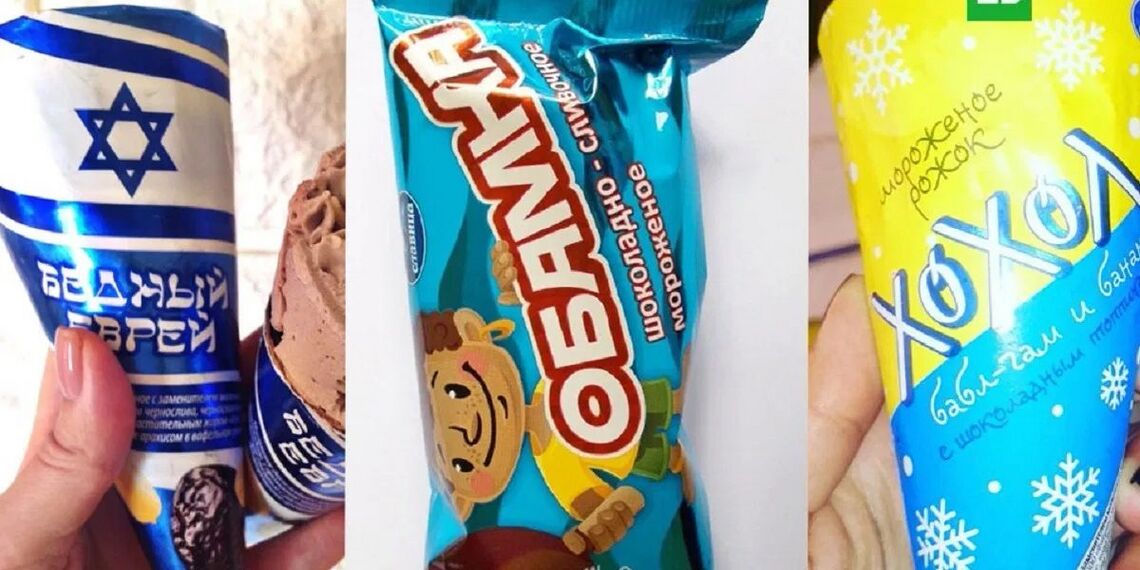
Slavitsa packaging, from left to right: “Бедный еврей” (“Poor Jew”), “Обамка” (“Little Obama”) and “Хохол” (“Khokhol”). The Obamka wrapper depicts a Black child; the other wrappers invoke Jewish and Ukrainian identities.

| Product | Imagery and response |
|---|---|
| “Obamka” (“Little Obama”), 2016 | A chocolate ice cream whose wrapper depicted a Black child. Slavitsa denied a political motive. Production was halted after accusations of racism.[8] |
| “Бедный еврей” (“Poor Jew”), 2018 | The wrapper combined an Israeli-flag design with Cyrillic lettering styled to resemble Hebrew. Jewish community leader Leonid Shteinberg called the product racist and demanded an end to production and sales.[9] |
| “Хохол” (“Khokhol”) | Named with a Russian ethnic slur against Ukrainians, with packaging in the blue and yellow of Ukraine’s flag.[9] |
See also
- Antisemitism and anti-Ukrainian propaganda
- Russia/Racism
- Russia
- Antisemitism
- Anti-Ukrainian racism
- Alexei Navalny
- Sergej Sumlenny’s threads on antisemitism
References
- ↑ 1.0 1.1 SOVA Research Center, “Radicalization of Far-Right Violence: Ideologically Motivated Crimes against Persons and Property and State Responses in Russia in 2025”, 9 February 2026, sections “Systematic Racist and Neo-Nazi Violence” and “Attacks against ‘Ethnic Outsiders’”.
- ↑ 2.0 2.1 Sergej Sumlenny, thread on Soviet and Russian antisemitism and anti-Ukrainian propaganda, 6 October 2023 (original, archived PDF).
- ↑ “Заболіло…”, Svoboda, 15 August 1981, no. 153, p. 2 (scan).
- ↑ Human Rights Watch, “Russia: Inadequate Response to Antisemitism in North Caucasus”, 9 November 2023.
- ↑ Mariana Irby, “‘Slavs Only’: Housing Discrimination in Russian Cities”, Jordan Center for the Advanced Study of Russia, New York University, 18 February 2021.
- ↑ Human Rights Watch, “Russia: Xenophobic Crackdown on Central Asian Migrants”, 17 March 2025, announcing Living in Fear and Humiliation: Rising Xenophobic Harassment and Violence towards Central Asian Migrants in Russia.
- ↑ Matthew Luxmoore, “Navalny’s Failure to Renounce His Nationalist Past May Be Straining His Support”, RFE/RL, 25 February 2021.
- ↑ Reuters, “Russian firm milks chilly US-Kremlin ties with ‘Little Obama’ ice cream”, 7 May 2016; The Moscow Times, “Russian Company Halts ‘Little Obama’ Ice Cream Production”, 11 May 2016.
- ↑ 9.0 9.1 RFE/RL’s Tatar-Bashkir Service, “Cone of Contention: ‘Racism’ Furor in Tatarstan over ‘Poor Jew’ Ice Cream”, 7 March 2018; Slavitsa’s product catalogue.