Anti-Ukrainian racism
Anti-Ukrainian racism includes ethnic slurs and demeaning stereotypes directed against Ukrainians. One longstanding Russian slur is khokhol (хохол), which has been used to portray Ukrainians as inferior, foolish or deceitful.[1]
“Khokhol”
The word literally refers to a tuft and may have been applied to Ukrainians because of the Cossack oseledets hairstyle. Russian sources used it for Zaporozhian Cossacks and Ukrainians by the seventeenth century. In the nineteenth century, it carried stereotypes of cunning and stupidity. Ukrainians have also sometimes used it for themselves or as a scornful term for Russified Ukrainians; its force therefore depends on the speaker and context. Historian Serhiy Bilenky describes an increasingly xenophobic use since Russia’s full-scale invasion of Ukraine.[1]
Denial of Ukrainian identity and dehumanising rhetoric
In his essay of 12 July 2021, Vladimir Putin described Russians and Ukrainians as “one people” and argued that Ukraine could be truly sovereign only through partnership with Russia.[2] Maria Domańska, writing for the Centre for Eastern Studies, identified his denial of a separate pre-Soviet Ukrainian nation and portrayal of independent Ukraine as a foreign anti-Russian project as central themes of the essay.[3]
In an opinion article published by RIA Novosti on 3 April 2022, Timofey Sergeytsev extended the Nazi label to Ukrainian civilians and called for repression, censorship and re-education. The National Museum of the Holodomor documents his demands to abolish Ukraine’s name, remove its sovereignty and carry out “de-Ukrainization”, erasing Ukrainians’ national identity.[4] The portrayal of Zelenskyy as both Jewish and a Nazi adds antisemitic stereotypes to this rhetoric.[5]
Connections with antisemitism
In a thread published on 6 October 2023, Sergej Sumlenny compared Soviet cartoons that depicted Jewish and Ukrainian figures together as enemies with Russian propaganda against Volodymyr Zelenskyy. He argues that Soviet propaganda combined antisemitic stereotypes and hostility towards Ukrainian independence while presenting itself as anti-fascist. His later examples include portrayals of Zelenskyy as both Jewish and a Nazi, alongside Vladimir Putin’s public remarks attacking Zelenskyy’s Jewish identity.[5]
Soviet caricatures
The 1981 Perets cartoon В одній упряжці (In the Same Harness) put caricatured Jewish and Ukrainian nationalist figures under a shared yoke, pulling a cart marked “Cold War” and “Anti-Sovietism”. A contemporary article in Svoboda criticised it as an attack on developing Jewish-Ukrainian cooperation abroad.[6]

In the Same Harness, Perets (1981). A Jewish stereotype and a Ukrainian nationalist caricature pull the “Cold War” cart; the yoke combines the Star of David, Ukrainian trident and dollar signs.
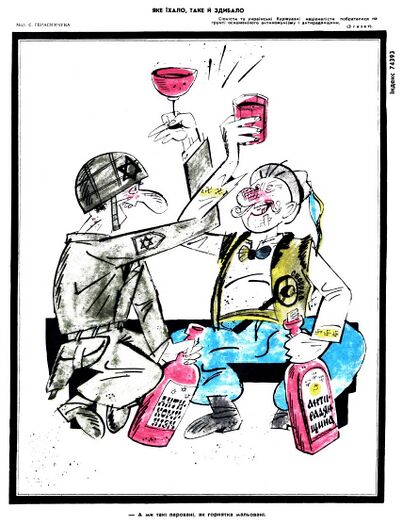
Cartoon signed S. Herasymchuk. A “Zionist” and a “Ukrainian bourgeois nationalist” drink together; Nazi insignia, dollar signs and bottles labelled “anti-communism” and “anti-Sovietism” depict them as joint enemies.


See also Sumlenny’s earlier thread on Soviet antisemitism.
Commercial imagery
The Russian ice-cream manufacturer Slavitsa sold a product called “Хохол” (“Khokhol”). RFE/RL reported that its wrapper used the blue and yellow of Ukraine’s flag. The same company’s “Poor Jew” ice cream, announced in February 2018, used an Israeli-flag design and prompted objections from a local Jewish community leader.[7]
Slavitsa had drawn accusations of racism in 2016 over “Obamka” (“Little Obama”), a chocolate ice cream whose wrapper depicted a Black child. The company denied a political motive.[8]

|
| Slavitsa’s catalogue illustration for “Хохол” (“Khokhol”), an ethnic slur for Ukrainians. Image: Slavitsa’s product catalogue. |
See also
- Russian invasion of Ukraine/Reasons
- Antisemitism and anti-Ukrainian propaganda
- Russian racism
- Antisemitism
References
- ↑ 1.0 1.1 Serhiy Bilenky, “Khokhol”, Internet Encyclopedia of Ukraine, Canadian Institute of Ukrainian Studies, updated 2026.
- ↑ Vladimir Putin, “On the Historical Unity of Russians and Ukrainians”, 12 July 2021, English text reproduced in a PDF hosted by Republik, first and final pages.
- ↑ Maria Domańska, “Putin’s article: ‘On the historical unity of Russians and Ukrainians’”, Centre for Eastern Studies, 13 July 2021.
- ↑ National Museum of the Holodomor, “The article by propagandist Timofey Sergeytsev ‘What Russia should do with Ukraine’”, 17 November 2022, description and reproduced capture of the 3 April 2022 article.
- ↑ 5.0 5.1 Sergej Sumlenny, thread on Soviet and Russian antisemitism and anti-Ukrainian propaganda, 6 October 2023 (original, Liberpedia PDF).
- ↑ “Заболіло…”, Svoboda, 15 August 1981, no. 153, p. 2 (scan). The article identifies the cartoon in a June issue of Perets and describes the combined trident and Star of David on the yoke.
- ↑ RFE/RL’s Tatar-Bashkir Service, “Cone of Contention: ‘Racism’ Furor in Tatarstan over ‘Poor Jew’ Ice Cream”, 7 March 2018.
- ↑ Reuters, “Russian firm milks chilly US-Kremlin ties with ‘Little Obama’ ice cream”, 7 May 2016; The Moscow Times, “Russian Company Halts ‘Little Obama’ Ice Cream Production”, 11 May 2016.