Nuland-Pyatt call
Nuland–Pyatt call refers to the leaked conversation between Victoria Nuland, then US assistant secretary of state for European and Eurasian affairs, and Geoffrey Pyatt, then US ambassador to Ukraine, made public in early February 2014 during Euromaidan. [1][2][3]
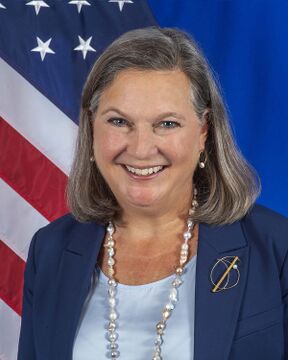
Victoria Nuland, official portrait, 2021. US Department of State; public domain.

Geoffrey Pyatt, official portrait, 2023. US Department of State; public domain.


Its political context was Viktor Yanukovych’s own proposal for a government under his presidency, rather than choosing a replacement president. On 25 January 2014, Yanukovych offered Arseniy Yatsenyuk the premiership and Vitali Klitschko the deputy premiership for humanitarian affairs. The proposed government would have served under Yanukovych.[4]
The January proposal and what followed
Nuland preferred Yatsenyuk to lead the government, with Klitschko and Tyahnybok outside it. The speakers also discussed calls to opposition leaders, UN envoy Robert Serry and possible encouragement from Joe Biden.[3]
That January arrangement never took office. Justice Minister Olena Lukash reported after the 27 January negotiations that Yatsenyuk had not agreed to head the government. Following Mykola Azarov’s resignation, Serhiy Arbuzov chaired the caretaker Cabinet; the government’s record of 29 January identifies him as acting prime minister. Yatsenyuk’s later appointment came after Yanukovych’s departure, in a different government.[5]
| Actor | Position in the published conversation | Events and outcomes |
|---|---|---|
| Viktor Yanukovych | Discussed as the incumbent president: Pyatt proposed further outreach to him. The proposed government would have served under his presidency, following his own January offer.[3][4] | Removed from office by Ukraine’s parliament on 22 February 2014, when it declared that he had abandoned his constitutional duties and called an early presidential election: 328 votes for, 0 against, 0 abstentions and 6 not voting (334 recorded in total). The vote was unanimous among those voting; the 328 supporters represented 72.9% of the Rada’s 450 seats.[6] |
| Arseniy Yatsenyuk | Nuland preferred him as prime minister in Yanukovych’s proposed government, with Yanukovych remaining president. | He refused Yanukovych’s offer. He became prime minister only on 27 February 2014, under acting president Oleksandr Turchynov: 371 votes for, 1 against, 2 abstentions and 43 not voting (417 recorded in total). The 371 supporters represented 82.4% of the Rada’s 450 seats.[5][7] |
| Vitali Klitschko | Nuland wanted him outside the government, rather than serving under Yatsenyuk. | He did not join the 27 February Cabinet. He won the 25 May Kyiv mayoral election with 56.7 percent.[7][8] |
| Oleh Tyahnybok | Nuland wanted him outside the government, with regular consultation. | He did not join that Cabinet. He contested the 25 May presidential election and received 1.16 percent.[7][9] |
| Oleksandr Turchynov | Not mentioned in the published call. | Parliament assigned him the presidential duties on 23 February 2014: 285 votes for, 0 against, 1 abstention and 53 not voting (339 recorded in total). The 285 supporters represented 63.3% of the Rada’s 450 seats.[7] |
| Petro Poroshenko | Not mentioned in the published call. | He won the 25 May presidential election in the first round, with 54.70 percent.[9] |
| The EU | Nuland said “Fuck the EU” while discussing UN involvement in brokering the proposed arrangement.[3] | Mass pro-European protests were already under way. The DIF/KIIS survey described hundreds of thousands demonstrating in Kyiv on 8 December 2013. Among the 1,037 Maidan participants surveyed on 7–8 December, 53.5% cited Yanukovych’s refusal to sign the EU association agreement as a reason for protesting, and 71% supported signing it. Respondents could select several reasons and demands.[10] |
Parliamentary vote and elections
On 22 February 2014, parliament declared that Yanukovych had abandoned his constitutional duties and called a presidential election for 25 May. The resolution passed with 328 votes in favor, none against and no abstentions; six registered deputies did not vote. The 328 votes represented 72.9 percent of the constitutional 450 seats. The later parliamentary appointments and popular elections are set out in the table above.[6]
See also
- Euromaidan
- Viktor Yanukovych
- NATO expansion
- Jeffrey Sachs’s use of the call
- Victoria Nuland
- Geoffrey Pyatt
References
- ↑ US Department of State, Office of the Historian, Victoria Nuland, appointments and term dates.
- ↑ US Department of State, Office of the Historian, Geoffrey R. Pyatt, appointment and mission dates.
- ↑ 3.0 3.1 3.2 3.3 Ukraine crisis: Transcript of leaked Nuland–Pyatt call, BBC News, February 2014 (accessible reproduction); the speakers’ exchanges, distinct from the accompanying commentary.
- ↑ 4.0 4.1 Justice Minister Olena Lukash’s announcement of the president’s offer, reported in Yanukovych offers premier’s post to Yatseniuk, Interfax-Ukraine, 25 January 2014; Ukrainian report reproducing her statement, Ukrainska Pravda, same date.
- ↑ 5.0 5.1 Olena Lukash’s statement after the 27 January talks, reported in Parliament will probe into government’s responsibility, Yatseniuk not ready to head cabinet, Interfax-Ukraine, 28 January 2014; Cabinet of Ministers of Ukraine, Mykola Azarov introduces Serhiy Arbuzov as acting Prime Minister, 29 January 2014. See also Yatsenyuk’s public rejection of the offer on 16 February, reported in Yatsenyuk’s statement rejecting Yanukovych’s offer, Interfax-Ukraine, 17 February 2014.
- ↑ 6.0 6.1 Verkhovna Rada of Ukraine, Resolution on the President’s self-withdrawal and early presidential elections, 22 February 2014, No. 757-VII; full resolution; official voting record, 22 February 2014, 17:11:55. For the constitutional composition of parliament, see the OSCE/ODIHR October 2014 election report, section IV.
- ↑ 7.0 7.1 7.2 7.3 Verkhovna Rada of Ukraine, Plenary meeting on February 23, 2014, vote assigning presidential duties to the parliamentary chairman; Cabinet of Ministers of Ukraine, Prime Minister of Ukraine and composition of Government appointed, 27 February 2014, parliamentary votes and full government composition. Official roll calls: Yatsenyuk’s appointment, 27 February 2014, 14:50:41; Turchynov’s presidential duties, 23 February 2014, 12:36:42.
- ↑ City of Kyiv, Vitali Klitschko: official biography, entry for 25 May 2014; Klitschko officially announced as winner of Kyiv mayor election, Interfax-Ukraine, 4 June 2014, reporting the commission’s approved protocol.
- ↑ 9.0 9.1 Central Election Commission of Ukraine, Official notification of the results of the 25 May 2014 presidential election, published in Uryadovyi Kurier; Parliamentary Assembly of the Council of Europe, Observation of the early presidential election in Ukraine (25 May 2014), Doc. 13543, especially paragraph 38 on Dobkin’s support from the Party of Regions.
- ↑ Ilko Kucheriv Democratic Initiatives Foundation and Kyiv International Institute of Sociology, Maidan-2013, 10 December 2013.