Czechoslovak monetary reform of 1953
On 1 June 1953, Czechoslovakia introduced new money and abolished the rationing system that had shaped everyday life since the Second World War. The change was presented as an advance towards a stronger currency and better supplies. For many households, it meant something much more immediate: cash and savings accumulated over years suddenly bought a fraction of what their owners had expected. An eligible person with 1,000 old koruny in cash received just 74 new koruny; a uniform change of denomination would have yielded 200.[1] Within hours, anger over money was producing strikes and demonstrations. In Plzeň, a major industrial city, the confrontation became an open challenge to Communist rule.[2]
The reform combined several different operations. It changed the unit in which wages, prices and accounts were expressed; imposed unequal conversion rates on existing money; cancelled particular financial claims; and replaced rationed and commercial prices with a unified system. Understanding these distinctions matters. Receiving fewer new banknotes did not, by itself, establish a loss: a purely proportional change could divide a person’s money, wages and prices by the same number. The confiscatory effect arose where the state converted assets on worse terms than the general change of denomination, or extinguished claims altogether.
Czechoslovakia was already living with the consequences of an earlier monetary settlement. The reform of November 1945 had restored a common currency after occupation and war. A limited amount of cash was exchanged freely, while the remainder was placed in blocked deposits, accessible only under specified conditions. These balances remained claims on paper, rather than money their owners could spend at will. Their survival became a central issue in the reform of 1953: what had once been immobilised would now be cancelled.[3]
Planning, shortages and secrecy
The immediate post-war inheritance was only part of the problem. After the Communist takeover in February 1948, the economy was reorganised around central planning, nationalisation and Soviet strategic priorities. Heavy industry and armaments absorbed resources that could otherwise have supported consumption. Collectivisation disrupted agriculture. The government faced shortages, pressure on living standards and a gap between the money people possessed and the goods available for purchase.[4]
Rationing concealed some of these pressures. On the rationed market, households used coupons to obtain limited quantities at controlled prices. Alongside it stood a legal commercial market with much higher prices, as well as illicit trading. Abolishing rationing while allowing all existing money to compete for goods risked an immediate surge in demand. The authorities chose to remove a large part of that purchasing power. They also used the operation to reduce the state’s financial obligations.[5]
Preparations were tightly restricted. The plan was already taking shape before President Klement Gottwald’s death in March 1953; it was not an improvised response devised over the final weekend of May. Only a small circle knew the details. According to Milan Bárta, even members of the Communist Party’s Central Committee were informed only on the morning of 30 May. Rumours nevertheless circulated, encouraging people to buy goods before their money could be devalued.[6]
The decisive public announcement came on Saturday, 30 May. Act 41/1953 was adopted that day, and the public heard the news through the radio that evening. Newspapers supplied details on Sunday. The new money entered circulation on Monday, 1 June, when the exchange began. The main exchange period ran through 4 June; the old currency ceased to be valid on 5 June.[7]
One familiar detail requires caution. Accounts frequently reproduce a categorical reassurance supposedly broadcast by President Antonín Zápotocký on 29 May, immediately before the announcement. In a 2018 interview, historian Zdeněk Jirásek said he had encountered no such broadcast in his research. He distinguished it from earlier reassurances that the currency was sound. The secrecy of the operation and the subsequent sense of betrayal are well documented; the famous last-minute quotation should not be presented as a securely established transcript.[8]
Secrecy also shaped the new currency itself. The notes were printed at Goznak in Moscow, and the coins were manufactured in Leningrad. The paper denominations included 1, 3, 5, 10, 25, 50 and 100 koruny. The unusual 3- and 25-unit values reflected Soviet influence over the design of the issue. This was a replacement of the circulating money, accompanied by a redistribution of its value.[9]


New 100-koruna note, 1953 issue, obverse and reverse. Scans by Tomáš Turnhöfer / Fix tom, CC BY-SA 4.0.[10]
Cash and savings conversion
All conversion ratios below mean old koruny for one new koruna. Thus, 5:1 means that five old koruny became one new koruna. The abbreviation Kčs was used for the Czechoslovak koruna.
For eligible individuals, the first 300 old Kčs in cash were exchanged at 5:1. Cash above that allowance was exchanged at 50:1. People outside the qualifying categories received the worse rate for their entire cash holdings.[11]
| Cash holding | Conversion |
|---|---|
| First 300 old Kčs per eligible person | 5:1 |
| Eligible person’s cash above 300 old Kčs | 50:1 |
| Entire cash holding of a person outside the qualifying categories | 50:1 |
Eligibility was explicitly social and administrative. People employing hired labour were excluded from the favourable allowance, as were those permanently excluded from rationed supplies under the relevant regulations. Temporary exclusion from rationing was different: certain cooperative members and small or medium farmers could still qualify, provided the national committee certified their household card. The implementing directive required identity documents and the household card, making the exchange both a financial operation and an exercise in administrative classification.[11]
Ordinary savings received more favourable treatment than substantial cash holdings, but the rate deteriorated as the balance increased. The bands applied successively: a larger balance did not cause every koruna in the account to be converted at the worst applicable rate.[12]
| Portion of ordinary savings, in old Kčs | Conversion |
|---|---|
| First 5,000 | 5:1 |
| Above 5,000 up to 10,000 | 6.25:1 |
| Above 10,000 up to 20,000 | 10:1 |
| Above 20,000 up to 50,000 | 25:1 |
| Above 50,000 | 30:1 |
The consequences become clearer through worked examples. An eligible person holding 1,000 old Kčs in cash received 60 new Kčs for the first 300 and 14 for the remaining 700: 74 new Kčs altogether. A uniform 5:1 conversion would have produced 200. A person holding 10,000 old Kčs in cash received 254 new Kčs, whereas the same sum in ordinary savings produced 1,800.[1]
| Illustrative holding | New Kčs received | Amount under a uniform 5:1 conversion |
|---|---|---|
| 1,000 old Kčs in eligible cash | 74 | 200 |
| 10,000 old Kčs in eligible cash | 254 | 2,000 |
| 10,000 old Kčs in ordinary savings | 1,800 | 2,000 |
| 50,000 old Kčs in ordinary savings | 4,000 | 10,000 |
These are calculations from the rules, rather than documented individual cases. They isolate the loss caused by unequal conversion. They do not measure every change in purchasing power, which also depended on the new prices. The distinction explains why describing a 50:1 conversion simply as a 98 per cent loss is misleading: against the general 5:1 denomination change, that portion retained one tenth of its comparable value, a loss of 90 per cent.
There were protected categories. Regular workplace savings, pupils’ savings, including school savings clubs, and remaining deposits from State Prize awards were converted at 5:1. These concessions depended on the kind of account. They did not establish an exemption for Communist Party members generally. Conversely, special rules subjected recent deposits on newly opened passbooks and current accounts to 50:1 conversion; the Finance Ministry’s retrospective table identifies deposits during 16–31 May in this category.[13]
Business and property income were also classified differently. The rules for surviving private industrial and commercial enterprises allowed limited operating funds to be converted at 5:1, subject to a ceiling related to the previous month’s wage bill; the remainder was converted at 50:1. Certain accounts receiving property-sale proceeds or rents were also subject to 50:1. There was therefore no single rate applicable to every account or every form of wealth.[14]
Other losses came through outright cancellation. Section 7 of the reform law extinguished blocked deposits dating from the 1945 settlement, specified domestic securities held in compulsory custody, and particular life-insurance claims payable into blocked deposits. It also cancelled obligations on post-1945 Czechoslovak state bonds and specified bonds issued by former credit institutions. The Currency Liquidation Fund was abolished. For affected creditors, the change eliminated a claim rather than merely changing its numerical expression.[15]
Life insurance requires particular precision. It is inaccurate to say that every policy was simply abolished. The Finance Ministry’s report distinguished claims written off as blocked money from insurance reserves converted at 20:1, and described the recalculation of surviving policies. The result could still be a severe loss, but cancellation and adverse conversion were legally and financially different operations.[16]
Wages, pensions and other recurring incomes were generally redenominated at 5:1. At the same time, rationing ended and unified retail prices replaced the old combination of rationed and commercial prices. Those new prices could be lower than the previous commercial prices while being substantially higher than the former rationed prices. A household’s experience depended on what it had previously been entitled to buy and where it had actually bought it.[17]
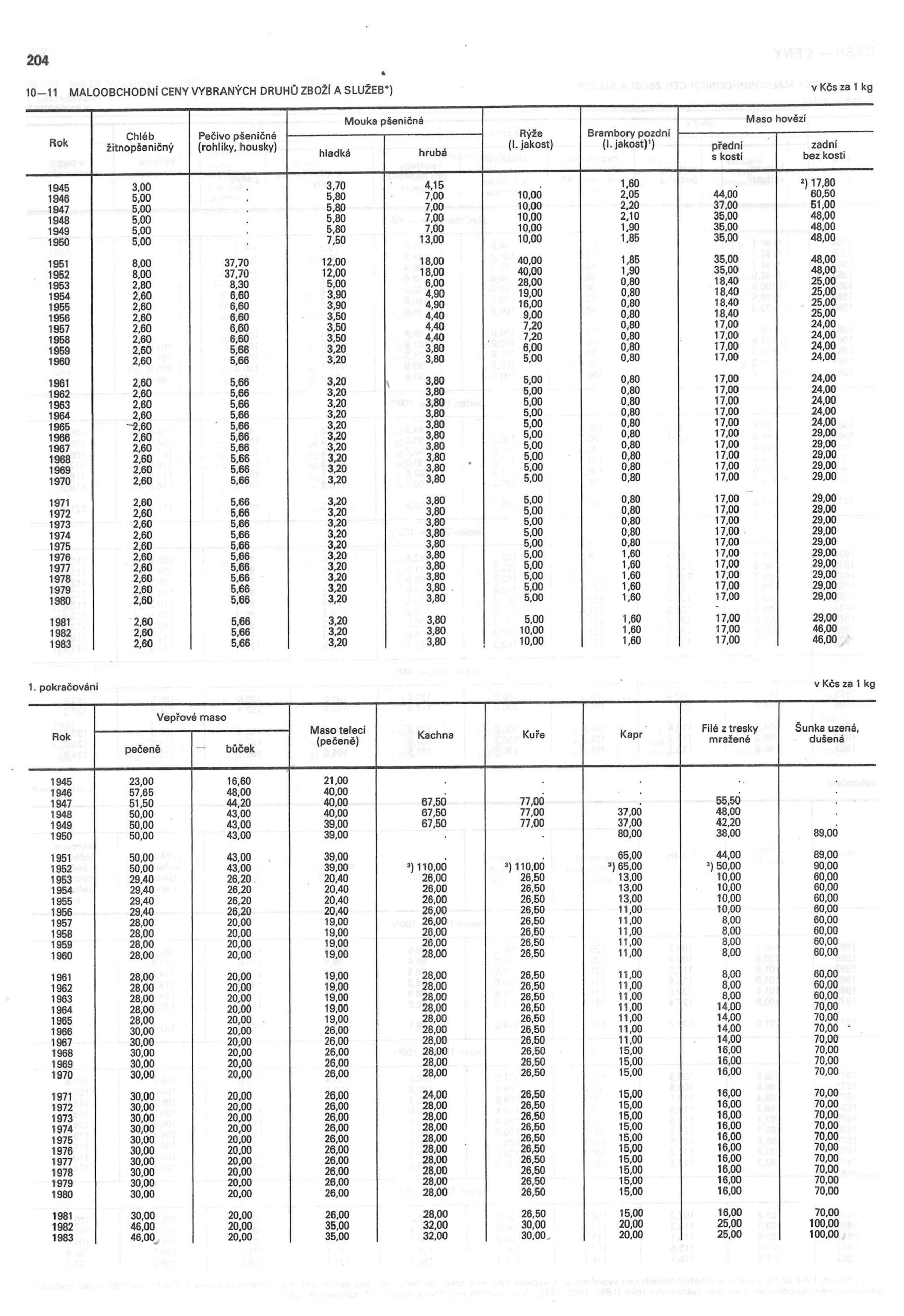
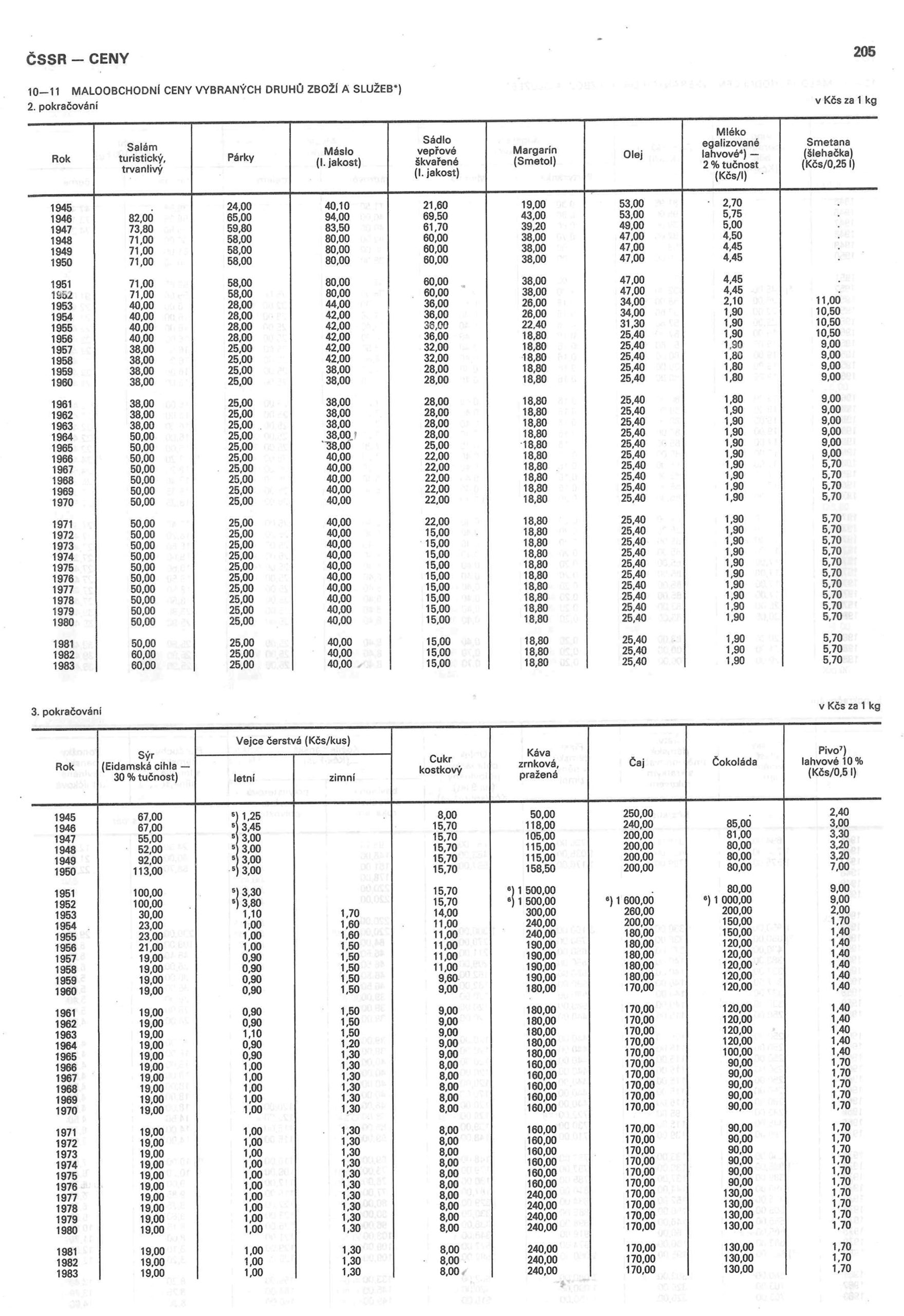
Concrete prices show how large the difference could be. The table below retains the old prices and then divides them by five to put them on the same monetary scale as the new prices. The old commercial market was a legal alternative to rationed purchases, not the black market. The comparisons concern specified goods and published prices; a rationed price was available only to those entitled to buy the quantity concerned.[18]
| Food, per kilogram | Before: rationed price, old Kčs → new-unit equivalent | Before: commercial price, old Kčs → new-unit equivalent | After: new Kčs | Increase over rationed price, on the same monetary scale |
|---|---|---|---|---|
| Bread | 8.00 → 1.60 | 16.00 → 3.20 | 2.80 | 75.0% |
| Coarse wheat flour | 18.00 → 3.60 | 38.00 → 7.60 | 6.00 | 66.7% |
| Butter | 80.00 → 16.00 | 450.00 → 90.00 | 44.00 | 175.0% |
| Cube sugar | 15.70 → 3.14 | 140.00 → 28.00 | 14.00 | 345.9% |
The nominal comparison of eight old koruny for bread with 2.80 new koruny conceals a price increase. At the 5:1 denomination rate, eight old koruny were equivalent to 1.60 new koruny: the new bread price was therefore three quarters higher than the former rationed price. Butter cost 2.75 times its old rationed-price equivalent, while cube sugar cost approximately 4.46 times as much. Against the old commercial prices, however, these same goods became cheaper: bread by 12.5%, butter by approximately 51.1% and cube sugar by 50%. These are calculations from the published prices, rather than a general consumer-price index.[18]
Children’s entitlements make the household effect particularly clear. Musilová’s table for children aged six to twelve lists four-week quantities of 5.25 kg of bread, 15.5 litres of milk, 0.5 kg of butter and 1.4 kg of sugar. These four items alone cost 169.08 old Kčs at the rationed prices, equivalent to 33.816 new Kčs. After the reform, the same quantities cost 87.30 new Kčs: approximately 53.48 more, an increase of 158.2%. This is a recalculated subtotal of four matched items, not the source table’s full total or a complete diet. It shows why losing the children’s cheaper rationed supplies could sharply increase a family’s food bill.[19]
Wages and household purchasing power
The government introduced compensating increases in wages and benefits. Regulation 42/1953 provided additions to hourly wage tariffs, including 0.34 new Kčs for workers outside the specified higher-rate categories and 0.70 for underground miners. Covered basic monthly salaries up to 1,000 new Kčs received an addition of 60, while salaries from 1,001 to 1,200 received 40. These provisions show that the package involved both losses and compensation. An increase in future income, however, did not restore a household’s destroyed stock of savings.[20]
For example, a covered basic monthly salary of 5,000 old Kčs became 1,000 new Kčs through denomination and then 1,060 with the 60-koruna addition, a 6% increase on the comparable base. A salary of 6,000 old Kčs became 1,200 and then 1,240, a 3.3% increase. These are applications of the statutory rules, not recovered individual payslips; bonuses, tax and family benefits could change the take-home result. Even so, they indicate the scale of the compensation alongside the much larger increases in particular former rationed prices.[20]
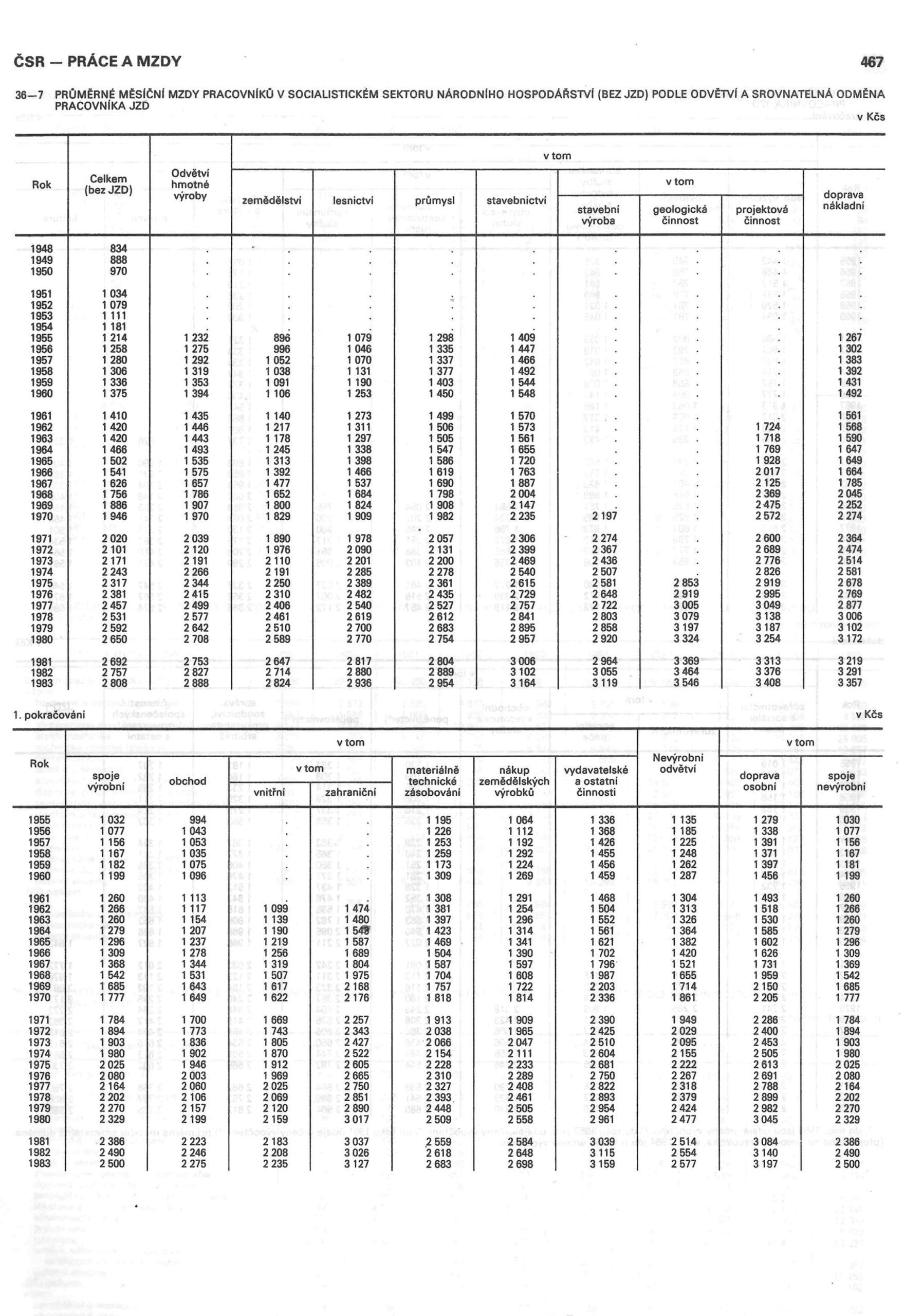
Official annual wage statistics provide a separate check on the scale of earnings. For the Czech part of Czechoslovakia, the 1985 historical statistical yearbook reports the following gross monthly averages for the socialist sector, excluding agricultural cooperatives. This is the yearbook’s ČSR regional series, not a total for the whole country. Its figures use comparable Kčs units, so the 1952 figure must not be mistaken for a wage paid in 1,079 old koruny.[21]
| Year | Average gross monthly wage, in comparable new Kčs | Meaning |
|---|---|---|
| 1952 | 1,079 | Equivalent to 5,395 old Kčs at 5:1; that old-unit amount is calculated |
| 1953 | 1,111 | Full-year average for the year of the reform |
| 1954 | 1,181 | Full-year average for the following year |
The increase from 1952 to 1953 in this Czech regional series was approximately 3.0% on the common monetary scale. These annual averages do not measure an individual’s pay change on 1 June or establish a national real-wage fall by themselves. They do show why a modest rise in nominal earnings could coexist with a severe deterioration in the affordability of goods previously bought on ration cards.[21]
A contemporary worker’s budget gives the numbers a human setting. In a request to leave his job, Prague road-service employee Václav Kučera reported June 1953 earnings of 1,814 new Kčs gross and 1,453.20 net. Living away from his family, he sent them 1,000 and spent 378 on meals at work. Those two expenses alone left 75.20 Kčs before travel and other personal needs. This was one man’s arrangement, not an average household budget, but it illustrates how little room even an employed worker could have for replacing lost savings or meeting an unexpected expense.[22]
The timing of pay created another source of hardship. Once wages had been paid in old cash, they could fall under the unfavourable cash-exchange rules. The Finance Ministry’s own account described efforts to rearrange May pay dates and acknowledged poor implementation. This helps explain why workers could see the operation as an immediate seizure of recently earned wages, rather than an attack confined to wealthy savers or former business owners.[23]
The state benefited through several channels: the reduction of money in circulation, cancellation of liabilities and changes in public accounts. These should not be collapsed into one undifferentiated total. The Finance Ministry’s retrospective report put the overall financial result of the exchange, conversions and cancellation of securities at approximately 3.509 billion new Kčs. That accounting result was not identical to households’ losses, the face value of debt cancelled, or the change in banknotes circulating. Some cancelled obligations were relationships between institutions already within the state sector.[24]
Privileges within the state apparatus must likewise be separated into distinct questions. Some benefits are directly documented. Others remain disputed. The clearest original evidence concerns pay, rather than a special rate for exchanging accumulated cash.
State personnel and disputed privileges
National Security Ministry Order 22, dated 30 May 1953, provided for service-pay conversion at 5:1 and a graded monthly compensation allowance for National Security and Border/Internal Guard personnel, effective from 1 June. The following figures are all new Kčs per month. They are neither amounts of old cash eligible for exchange nor evidence of a 3:1 cash entitlement.[25]
| Monthly service pay before the special addition | Monthly addition |
|---|---|
| Up to 1,600 | 200 |
| 1,601–1,800 | 180 |
| 1,801–2,000 | 160 |
| 2,001–2,200 | 140 |
| 2,201–2,400 | 120 |
| 2,401–2,600 | 100 |
| 2,601–2,800 | 60 |
| 2,801–3,000 | 40 |
| 3,001 and above | 0 |
The service-pay basis was not necessarily identical to the civilian basic-salary basis, so comparisons require care. Later ministry orders dealt with conversion of arrears, advances and particular pay additions. Order 40 corrected cases in which specified May additions had been converted at 50:1 instead of 5:1. These documents establish preferential or corrective treatment of income; they do not establish a secret conversion rate for personal fortunes.[26]
Separate exchange centres for military and security personnel are not, by themselves, evidence of a better rate. The regular schedules described in the archival studies were the familiar first-300-at-5:1 and remainder-at-50:1 arrangement. Secret Order 90 instructed the security ministry’s exchange commissions to follow State Bank instructions. Jiří Bílek also records abuses in which officers used conscripts’ unused allowances to exchange the officers’ own money on better terms. Such conduct exploited the ordinary scheme; it does not demonstrate a lawful universal concession for officers.[27]
The often-repeated 3:1 claim rests on a different evidential footing. Zdeněk Jirásek and Jaroslav Šůla’s 1992 book reports that rate for career officers and certain categories of security personnel on p. 105. The short public excerpt confirms the attribution, but the complete page and an original instruction establishing the entitlement remain unverified. The exact categories, the amount covered and named individual beneficiaries remain unresolved.[28]
Zbyšek Šustek directly challenged the claim in 2014. On p. 22, footnote 68, he wrote: “Informácia sa však neopiera o nijaký pramenný materiál” — “But the information is not based on any source material.” His main discussion places the reported rates among contemporary rumours and argues that 3:1 or 1:1 would have provided a bonus above a loss-free 5:1 denomination change. His conclusion is a published criticism, rather than an original order disproving the concession.[29]
The arithmetic behind that criticism is straightforward. For a given old sum, 3:1 produces approximately 1.67 times as much new money as 5:1; 1:1 produces five times as much. This establishes the size of a possible reward relative to that benchmark. It cannot establish that a government was incapable of granting one. The historical question remains whether such a concession was actually authorised and implemented.
Documented benefits for particular accounts or service-pay categories do not establish an unlimited exchange concession for Communist Party members generally. Jirásek’s 2018 interview describes a narrow senior group without supplying a numerical rate.[30]
Gold parity and international institutions
The reform also changed the currency’s international framework. The new official gold content was 0.123426 grams per koruna, with a corresponding dollar parity of 7.20 new koruny to one US dollar. This was an official valuation, not a promise that citizens could freely exchange their money for gold or foreign currency. Czechoslovakia changed the parity without prior consultation with the International Monetary Fund, arguing that its action did not require the Fund’s concurrence. The dispute developed into a wider conflict over membership obligations, ending in compulsory withdrawal effective on 31 December 1954.[31]
The World Bank relationship ended on the same date, but the institutional history identifies a distinct issue: failure to pay the balance of the country’s capital subscription. Suspension began on 31 December 1953, and membership ceased a year later. Treating both departures simply as one automatic punishment for the monetary reform obscures their different formal grounds.[32]
Monetary power, property and liquidity
The confiscatory element lay in the alteration of claims without their holders’ consent. A uniform change of denomination would have changed the numbers while preserving their proportions. Unequal conversion and cancellation instead redistributed existing claims. The state acted both as the authority defining the monetary unit and as a debtor able to extinguish obligations owed to its own population.
An Austrian reading also distinguishes monetary claims from the goods they can buy. Nominal balances did not remove shortages of consumer goods. Administered prices and rationing restricted the choices through which those balances could be used; the reform then imposed losses on their holders. The published price comparisons make these separate mechanisms visible.
The case also distinguishes bank liquidity from political security. Full cash backing of a claim would not protect its holder if the authority controlling that cash could impose a worse conversion rate or cancel the claim itself. Likewise, a statutory gold parity was not the same as an enforceable right to obtain gold. The questions include who may choose the money, what a contract promises, and who can change those terms by force.
Resistance and the Plzeň protests
The losses prompted strikes and demonstrations across Czechoslovakia. A National Security Ministry assessment cited by Milan Bárta recorded organised strikes in 129 enterprises with 32,359 employees; these figures do not cover every interruption of work. Discontent also appeared among Communist Party members, whose reactions ranged from loyal criticism to support for striking colleagues.[33][34]
Plzeň became the most conspicuous confrontation. On 1 June 1953, workers marched from the former Škoda works to the city centre; economic demands developed into calls for free elections. Czechoslovak forces suppressed the protests, and punishment continued through trials, employment and housing. The confrontation and its aftermath are discussed in Plzeň protests of 1953.[35][36][37]
See also
References
- ↑ 1.0 1.1 Editorial calculations from the preceding schedules. Cash: 1,000 → 300/5 + 700/50 = 74; 10,000 → 300/5 + 9,700/50 = 254. Savings: 10,000 → 5,000/5 + 5,000/6.25 = 1,800; 50,000 → 1,000 + 800 + 1,000 + 1,200 = 4,000. For the distinction between denomination and losses of up to 90 per cent, see Ústav pamäti národa, Menová reforma 1953, PDF p. 2, explanatory panel on the measures’ complexity.
- ↑ Act 41/1953 Sb., “Zákon o peněžní reformě”, 30 May 1953, §§4–8, 12. For the immediate protests, Jiří Pernes, “Rok 1953 v Československu”, Paměť a dějiny 2013/03, pp. 20–21.
- ↑ Česká národní banka, “Košický vládní program”, unpaginated, paragraph on the November 1945 exchange and blocked deposits. Cancellation in 1953: Act 41/1953, §7(1)(a).
- ↑ Pernes, “Rok 1953”, printed pp. 15–16, especially p. 16 on armaments, agricultural disruption and pressure on living standards. See also Milan Bárta, “Peněžní reforma 1953 ve zprávách ministerstva národní bezpečnosti”, Paměť a dějiny 2013/03, p. 58.
- ↑ Česká národní banka, “Peněžní reforma”, unpaginated, opening paragraph on purchasing power, the two markets and internal indebtedness; Bárta, “Peněžní reforma”, p. 58, on rationing and the commercial market.
- ↑ Bárta, “Peněžní reforma”, p. 58, on restricted preparations, the Central Committee’s notification on 30 May and the buying rush. Jirásek’s 30 May 2018 interview, answers on the preparation of the plan, dates earlier deliberations to 1951–1952. No claim is made that all Party members had advance knowledge.
- ↑ Act 41/1953, dated 30 May, §§5, 12; Bárta, “Peněžní reforma”, p. 58, on the radio announcement, Sunday newspapers and Monday exchange. Jan Neckář, Petr Mrkývka et al., Evoluce finančního práva (Brno: Masarykova univerzita, 2023), ch. 10, §10.1, printed p. 191, on 1–4 June and invalidation from 5 June. The chapter’s individual author is not securely identified in the volume’s contributor list, so the collective volume is cited.
- ↑ Jirásek, interview of 30 May 2018, answers beginning with the question about the alleged 29 May broadcast. He explicitly distinguishes the unlocated last-minute speech from earlier assurances. The alleged broadcast is therefore not quoted here as an authenticated primary source.
- ↑ Česká národní banka, “Státní banka československá a peněžní reforma 1953”, unpaginated, paragraphs beginning “Zásadní změnu…” and “Do hodnoty 5 Kčs…”. Formally, the 1-, 3- and 5-koruna paper issues were state notes; denominations from 10 koruny were State Bank banknotes.
- ↑ Tomáš Turnhöfer / Fix tom, Wikimedia Commons, “Bankovka ceskoslovensko 100 lic 1953” and “Bankovka ceskoslovensko 100 rub 1953”, CC BY-SA 4.0.
- ↑ 11.0 11.1 Finance Ministry Directive 159/1953 Ú. l., “Směrnice o způsobu provedení peněžní reformy”, 30 May 1953, effective 1 June, art. 2(a), (b), (d). The as-issued official text reproduction distinguishes permanent exclusion under point 3 of Internal Trade Directive 11/1953 from temporary exclusion under point 4; art. 2(d) specifies the household-card endorsement.
- ↑ Bárta, “Peněžní reforma”, p. 59, conversion schedule and its explicit reference to the remainder within successive bands. Neckář, Mrkývka et al., Evoluce finančního práva, ch. 10, §10.1, p. 191, discusses differentiated treatment and aggregation by depositor. These are ordinary savings rules, not a complete schedule for every institutional account.
- ↑ Neckář, Mrkývka et al., Evoluce finančního práva, p. 191, protected savings categories. Czechoslovak Finance Ministry, August 1953 report, published as document 1 in Dana Musilová, Měnová reforma 1953 a její sociální důsledky: studie a dokumenty (Praha: Ústav pro soudobé dějiny AV ČR, 1994), printed p. 57, PDF ordinal p. 52, table on recent deposits. This narrow description follows the ministry’s table; modern summaries differ in whether they describe the cutoff as after 15 or after 16 May, and whether they speak of recent deposits or newly opened accounts.
- ↑ Neckář, Mrkývka et al., Evoluce finančního práva, printed p. 192, reproducing differentiated rules for private enterprises, property proceeds and rents. The operating-funds provision excludes the specified small and medium agricultural enterprises from its stated private-business category.
- ↑ Act 41/1953, §7(1)(a)–(c), §7(2), §8. Section 7(1)(c) specifies insurance claims payable by credit to a blocked deposit; it does not cancel every life-insurance policy. See also Neckář, Mrkývka et al., Evoluce finančního práva, p. 192.
- ↑ Finance Ministry report, Musilová, document 1, printed p. 58, PDF ordinal p. 53, section 3, “Přepočet životního pojištění”; continuation on printed p. 59. The 20:1 treatment concerns the relevant insurance reserves used to calculate future claims; blocked-money claims are identified separately.
- ↑ Act 41/1953, §4; ČNB, “Peněžní reforma”, paragraph on income conversion and real wages; Bárta, “Peněžní reforma”, p. 59, on the new prices’ relationship to the former rationed and commercial markets. “Free” sale without ration cards remained sale at administered prices.
- ↑ 18.0 18.1 Musilová, Měnová reforma 1953, printed pp. 28–29, tables 2–3, PDF ordinal pp. 25–26; the earlier rationed/commercial unit-price comparison is on printed p. 13, PDF p. 10. Cross-check: Federální statistický úřad et al., Historická statistická ročenka ČSSR (Praha: SNTL/ALFA, 1985), p. 204, table 10–11 (bread and flour) and p. 205, continuation of table 10–11 (butter and cube sugar), rows 1952 and 1953, reproduced by ČSÚ in Pavel Hortig, “Přehled průměrných mezd a maloobchodních cen v bývalém Československu”, 17 August 2022. Official scan of p. 204; p. 205. The yearbook gives annual labelled price observations, while Musilová supplies the explicit before/after comparison. Ratios, new-unit equivalents and percentage changes are editorial calculations. The figures do not imply unlimited access to rationed goods or identical product grades across every price series.
- ↑ Musilová, printed p. 29, table 3, PDF ordinal p. 26, “Základní potraviny – dávka na 4 týdny (děti 6–12 let)”. Selected old-price subtotal: 42 + 65.10 + 40 + 21.98 = 169.08 old Kčs; divided by five = 33.816. Selected new-price subtotal: 14.70 + 31 + 22 + 19.60 = 87.30. Increase: 53.484 new Kčs, or 158.1618%, rounded in the text. This uses four individual rows and does not reproduce or rely on the printed table’s aggregate total. The milk prices here are those in Musilová’s ration comparison; they should not be conflated with the yearbook’s separately specified bottled 2%-fat milk series.
- ↑ 20.0 20.1 Government Regulation 42/1953 Sb., “O opatřeních v oboru mezd, důchodů a některých sociálních dávek v souvislosti se zrušením lístkového systému zásobování”, 30 May 1953, §1(1)(a), §1(2), §2. The quoted wage provisions survive in the legal-text reproduction; the regulation’s later consolidated version omits some original pension provisions, which are not reconstructed here. Amounts in this paragraph are new Kčs.
- ↑ 21.0 21.1 Historická statistická ročenka ČSSR (1985), printed p. 467, table 36–7, ČSR section (Czech part of Czechoslovakia), “Průměrné měsíční mzdy pracovníků v socialistickém sektoru národního hospodářství (bez JZD) podle odvětví a srovnatelná odměna pracovníka JZD”, first column “Celkem (bez JZD)”, rows 1952: 1,079; 1953: 1,111; 1954: 1,181. ČSÚ’s official page scan, including the regional page header; accompanying ČSÚ article, section “A jak se měnily mzdy?”, explains the gross-wage measure. The reconstructed 5,395 old Kčs and 2.9657% growth are calculated. These are not Czechoslovakia-wide wage averages and should not be spliced into other historical series. A full-year average for 1953 is not a June payslip or an isolated measurement of the reform’s effect.
- ↑ Musilová, printed pp. 31–32, PDF ordinal pp. 28–29, Kučera example; p. 31 identifies the case with note 68. The 75.20 remainder is independently calculated from net pay minus the stated family contribution and workplace meals. The book’s subsequent closing arithmetic and wording about railway spending are internally inconsistent; they are not adopted here. Musilová cites the underlying archival request.
- ↑ Finance Ministry report, Musilová, document 1, printed p. 59, PDF ordinal p. 54, section 4, “Změny výplatních termínů mezd a penzí”. The report explains the May arrangements and acknowledges failures of implementation. This is the ministry’s retrospective account, not a claim that every worker was paid on the same date.
- ↑ Finance Ministry report, Musilová, document 1, printed p. 81, PDF ordinal p. 76, paragraph identifying 3,509 million new Kčs as the total financial result and distinguishing the treatment of internal state-sector obligations. This is the ministry’s stated accounting result.
- ↑ National Security Ministry Order 22, 30 May 1953, art. 66(1), (3), (7), PDF p. 1; Slovak implementing annex, own pp. 1–2, PDF pp. 2–3. The annex supplies the explicit zero above 3,000 and defines the service-pay basis. Archival identification through Bárta 2014, p. 75 n. 136: ABS, A6/4, inv. j. 72. The minister’s signature identifies the issuer, not proof of personal receipt.
- ↑ Order 27/1953, 8 June, art. 72, printed pp. 75–79; Order 40/1953, 28 July, art. 125, printed p. 125, PDF p. 2. These concern pay, arrears and advances, rather than an accumulated-cash concession.
- ↑ Milan Bárta, “Podíl československé Bezpečnosti na přípravě a provedení měnové reformy v roce 1953”, Securitas imperii 24 (1/2014), p. 73. Jiří Bílek, “Československá armáda a měnová reforma v roce 1953”, Historie a vojenství 44, no. 1 (1995), pp. 66–91, at p. 87, nn. 39–41, on regular rates and abuses. Secret Order 90, 30 May 1953, art. 95, pp. 1, 3, establishes organisation and State Bank compliance; it does not itself print the numerical rates.
- ↑ Zdeněk Jirásek and Jaroslav Šůla, Velká peněžní loupež v Československu 1953 aneb 50:1 (Praha: Svítání, 1992), p. 105, ISBN 80-900238-9-4. National Library page and public search excerpt, digital image 115/180. Order 27, p. 79, identifies Finance Ministry circulars 282/53.756/53 of 1 June and 152/54.885/53 of 5 June; neither is established here as authority for 3:1. Bílek, p. 87 nn. 39–40, identifies military documents VHA–MNO čj. 007585 FS 1953 and 17323 FS 1953, not established as evidence for this concession. These are documentary leads, not evidence that they contain the concession.
- ↑ Zbyšek Šustek, “Menová reforma v Československu v roku 1953 a jej hospodársko-politické pozadie”, Pamäť národa 1/2014, printed pp. 22–23, especially p. 22 n. 68, PDF pp. 24–25. Footnote 68 is entirely on p. 22; the main-text paragraph continues on p. 23.
- ↑ Zdeněk Jirásek, interview of 30 May 2018, answer on Party benefit; he describes a narrow senior group without specifying a numerical exchange rate.
- ↑ IMF, Annual Report 1954, p. 86, “Other Changes in Official Exchange Rates”, on the new gold content, dollar parity and Czechoslovakia’s legal argument. J. Keith Horsefield, The International Monetary Fund 1945–1965, vol. I, ch. 14, “A Question of Obligations (1953–54)”, sections “Czechoslovakia Leaves the Fund” and “Par Value”, unpaginated online. The historical sequence culminates in required withdrawal, not an automatic expulsion on the day of the reform.
- ↑ World Bank Group Archives, “Czechoslovakia ceases to be World Bank member”, entry dated 31 December 1954, with the suspension dated 31 December 1953 and the stated unpaid-capital grounds. The entry links the relevant Board resolution and archival record.
- ↑ Bárta, “Peněžní reforma”, p. 59, including n. 12. The 129 enterprises and 32,359 employees come from a National Security Ministry assessment dated 17 June 1953, ABS, A2/1, inv. j. 122, as cited by Bárta. The assessment is cited through Bárta. Pernes, “Rok 1953”, p. 21, reports approximately 130 strikes and gives regional examples; the two figures need not describe identical units of counting.
- ↑ Jakub Šlouf, “Okradená strana: Protesty členské základny KSČ proti měnové reformě v roce 1953”, Securitas imperii 32 (1/2018), pp. 250–285, especially p. 263 and pp. 284–285. These passages distinguish social interests, loyal Communist criticism, support for strikes and the uneven disciplinary response.
- ↑ Jakub Šlouf, “Rozvrat lokálního stranického a bezpečnostního aparátu v průběhu plzeňských demonstrací 1. června 1953”, in Jiří Petráš and Libor Svoboda (eds.), Osm let po válce: Rok 1953 v Československu (Praha / České Budějovice: ÚSTR / Jihočeské muzeum, 2014), pp. 295–305, at pp. 297–298, especially p. 298 nn. 27–30. See also Jakub Šlouf, “Protest im Kommunismus: Die Pilsner Revolte vom 1. Juni 1953”, Bohemia 58/1 (2018), pp. 78–108, at pp. 93–94, on the main plant, Doudlevce and the march after failed negotiations. Printed pages 297–298 correspond to PDF pp. 298–299 in Osm let po válce.
- ↑ Pavel Marek, “Protikomunistické demonstrace v Československu v roce 1953”, Securitas imperii 24 (1/2014), p. 26 for the chants, pp. 26–27 and p. 26 n. 101 for the town hall, Beneš portrait, municipal loudspeakers and cut electricity, and p. 27 for the court and blocked approach to the regional radio station. The street public-address system was distinct from the regional broadcaster. The English slogans translate “Chceme naše peníze” and “Chceme svobodné volby”; they are quoted through Pavel Marek, “Protikomunistické demonstrace v Československu v roce 1953”, Securitas imperii 24 (1/2014), not an independently inspected sound recording. His p. 26 n. 99 itself questions the often-repeated story of an arrested negotiating delegation; that disputed sequence is not adopted here.
- ↑ Bárta, “Podíl československé Bezpečnosti”, p. 67, especially n. 89, on the 43 officers and 1,236 soldiers, citing Jiří Bílek, “Československá armáda a měnová reforma v roce 1953”, Historie a vojenství 44/1 (1995), p. 77; p. 67 n. 90 and the surrounding text on shots, beatings, the evening curfew and continuing arrests. Pavel Marek, “Protikomunistické demonstrace v Československu v roce 1953”, Securitas imperii 24 (1/2014), pp. 27–29, describes fire hoses and the clearing of the square; p. 24, nn. 89–90, identifies domestic suppression and reports no deaths on either side. The statement concerns the street confrontation, not the subsequent experiences of prisoners.